

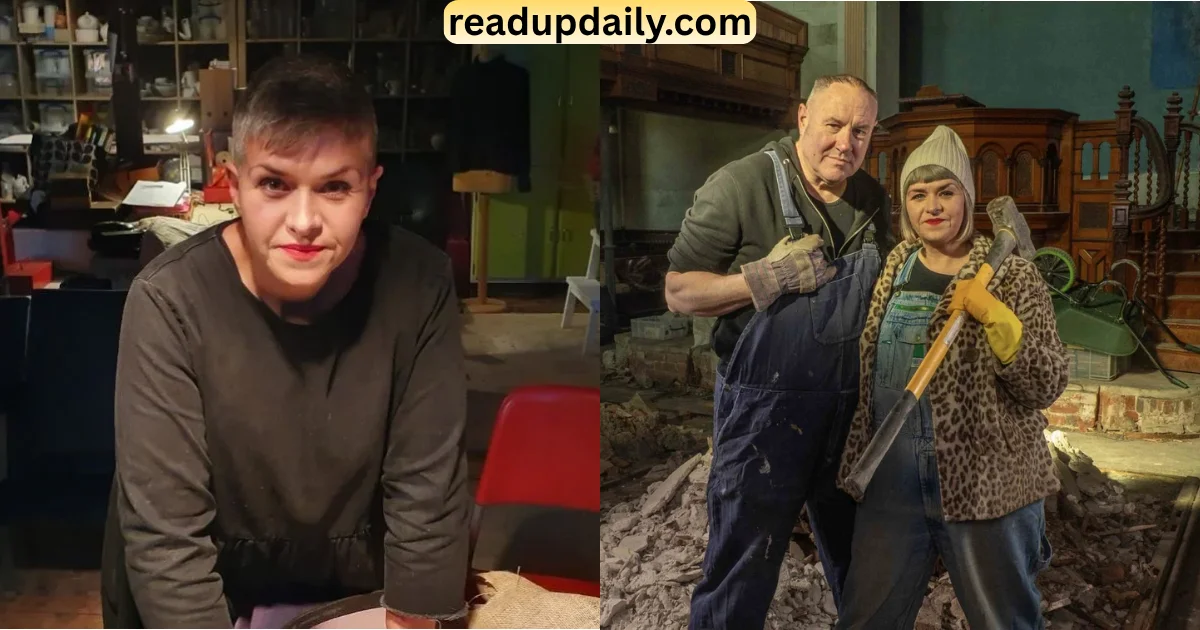
Marj Hogarth is a Scottish actress, voice performer, and designer. Her career now spans more than three decades. It covers stage, screen, radio, and sustainable craft. Marj Hogarth is best known for playing Fiona in the cult BBC sitcom Still Game. But she has built one of Scottish entertainment’s most varied résumés. She has moved between television comedy, radio sitcoms, pantomime, and children’s drama. In recent years, she has taken on a very different chapter too. She is renovating a derelict Welsh chapel with her husband, ceramicist Keith Brymer Jones. She also runs her own sustainable design brand, Hook & Hatchet. This article covers her life, career, relationships, and creative projects in full.
Who Is Marj Hogarth?
At her core, Marj Hogarth is a working actress. She has never chased the spotlight the way many of her peers have. She built her name through steady, reliable performances rather than one big hit. Scottish audiences know her instantly from Still Game. Radio comedy fans know her voice from Fags, Mags and Bags on BBC Radio 4. Beyond acting, she has built a second identity as a maker and designer. This proves a long creative career rarely follows one straight path. Her story is one of steady craft and reinvention. She has a genuine love of storytelling, whether it’s spoken, performed, or handmade.
Early Career and Background
Details about Marj Hogarth’s early life remain private. No verified public record confirms her exact birth date. What is documented is her long history in Scottish theatre and broadcasting. Before television fame, she performed widely on stage across Scotland. She took on both comedic and dramatic roles. This work sharpened her instincts for timing and character. Her theatrical grounding later gave her screen work a natural, lived-in quality. Like many actors of her generation, she built her name gradually. She started with supporting roles that demanded reliability over headline status. This laid the foundation for the career that followed.
Marj Hogarth’s Breakout Role in Still Game
Hogarth’s most recognised role came through Still Game. The sitcom was created by and stars Ford Kiernan and Greg Hemphill. <cite index=”10-1″>In the series, she played Fiona, the daughter of the character Jack Jarvis. She appeared in three episodes: “Dug,” “Hoaliday,” and “One In, One Out.”</cite> Fiona was a Craiglang-born woman who emigrated to Ontario, Canada. Her visits home carried real emotional weight in the show. <cite index=”10-1”>Jack and Victor travel to Canada to visit her in “Hoaliday.” Fiona later flies home to see her father in hospital after his heart attack in “One in One Out.”</cite> Her screen time was limited next to the lead cast. Even so, Fiona’s storylines carried genuine emotional stakes.
The Cultural Impact of Still Game on Her Career
Still Game first aired on BBC One Scotland in 2002. It became a defining piece of Scottish popular culture. The show ran for many years, plus several live arena tours. Being tied to a show this big gave Marj Hogarth lasting recognition. This went well beyond a single guest appearance. She only appeared in a handful of episodes. Even so, her Fiona became a familiar reference point for fans. Her name remains permanently linked to the show’s legacy. She has generally avoided the celebrity spotlight throughout her career. Still, this connection remains one of the most lasting parts of her public profile. Fans and interviewers still bring it up today.
Voice Work on Fags, Mags and Bags
Marj Hogarth also built a strong reputation in BBC Radio 4 comedy. She had a recurring role in Fags, Mags and Bags. Sanjeev Kohli created and stars in the sitcom, set around a Glasgow shop. Hogarth voiced characters in this world across multiple series. This required a very different discipline from television work. Radio comedy relies entirely on vocal timing and tone. There are no visual cues to support a joke or an emotional beat. Listeners came to know her comic rhythm well. She made each character feel distinct through voice alone. This skill speaks to her range and her grasp of comic pacing, honed over years on stage.
The Karen Dunbar Show and Sketch Comedy
Early in the 2000s, Hogarth joined the ensemble cast of The Karen Dunbar Show. It was a Scottish sketch comedy series, running from roughly 2003 to 2006. This period showed a different side of her comedic ability. It required fast shifts between characters, accents, and comic styles within one episode. Sketch comedy is famously demanding work. Performers must establish a character convincingly within seconds. Her work here helped cement her reputation. She became known as a dependable, adaptable comic performer in Scottish entertainment. It also added real range to a résumé that already included stage drama and sitcom acting. This reinforced her name as a true jack-of-all-trades.
Marj Hogarth in Children’s Television
Hogarth also brought her talents to family and children’s programming. She is best known here for the CBBC series M.I. High. The show followed teenage secret agents balancing school life with espionage missions. Children’s television demands a particular kind of discipline. Clarity, warmth, and energy must come through without losing authenticity. Her role brought a lighter, whimsical counterpoint to the show’s young cast. She still kept a firm, distinct presence throughout. This chapter widened her audience considerably. It introduced her to families and younger viewers. Many of them had not seen her earlier work in adult sitcoms like Still Game or radio comedy.
Animation and Voice Acting Credits
Marj Hogarth has also contributed to animated storytelling. She voiced characters in the animated series Ronan the Amphibian. This further showed the versatility she built through years of radio comedy. Voice acting for animation is a different creative challenge from live performance. A character’s whole personality must come through vocal choices alone. This experience complemented her radio comedy background well. It reinforced a skill set built around vocal storytelling rather than physical presence. Together, her animation and radio credits highlight a lesser-known part of her output. This work runs in parallel to her more visible television and stage career.
Pantomime and Stage Villainy at Eden Court Theatre
Theatre has remained a constant thread throughout Hogarth’s career. This is especially true of her pantomime work at Eden Court Theatre in Inverness. She took on classic villain roles here. These include Carabosse in Sleeping Beauty and the Wicked Queen in Snow White. She delighted audiences with commanding stage presence and theatrical flair. Pantomime villains need a specific blend of menace and comic exaggeration. Audiences of both children and adults responded well to her performances. These roles reflect her theatrical roots. They also show her comfort with larger-than-life characterisation. This contrasts with the grounded, naturalistic style she is known for on television. It proves her range goes far beyond sitcom comedy.
Marj Hogarth’s Marriage to Keith Brymer Jones
One widely discussed part of Hogarth’s life is her marriage to Keith Brymer Jones. He is a celebrated British ceramicist, author, and television personality. Many know him as a judge on The Great Pottery Throw Down. The couple represent a union of two very different creative worlds: acting and pottery. Keith often speaks openly about their life together, in interviews and on social media. Marj has generally preferred to stay further from the public eye. Their relationship is often described as a balance between fame and privacy. It shows that a deeply creative partnership can thrive without equal public exposure on both sides.
Life in Kent and the Move to Wales
For many years, Marj Hogarth and Keith Brymer Jones shared a home on the Kent coast. They lived in Whitstable and Margate, while Keith ran his pottery studio nearby. This period grounded their life in a well-established creative community. Then everything changed. The couple made a bold decision to relocate to North Wales, more than 300 miles away. They left behind a familiar coastal setting for an entirely different landscape and culture. Hogarth has spoken about how freeing this felt. She has described not being tied to somewhere familiar as a relief. She calls the move a deliberate leap into the unknown. It went on to reshape both their professional and personal lives.
Capel Salem: Restoring a 19th-Century Welsh Chapel
The centrepiece of their life in Wales is Capel Salem. It is a derelict 19th-century chapel in Pwllheli. The couple bought it to turn into a home, art studio, and creative hub. When they took it on, the building was in a severe state of disrepair. It suffered from dry rot, missing roof slates, and blocked gutters. It had also been abandoned for over a decade. Restoring a building of this scale needed real financial commitment. It also demanded patience and creative problem-solving. This turned the project into far more than a simple renovation. For Marj, the process became a defining, transformative experience. It shaped both her personal life and her identity as a maker.
Our Welsh Chapel Dream: Documenting the Journey
The couple’s restoration has been documented on Channel 4, in the series Our Welsh Chapel Dream. It follows their progress turning Capel Salem from a ruin into a livable space. The show has returned for multiple series. It captures both the setbacks and the milestones of the project. These include a finished living area, an entrance lobby, and a guest suite. Many parts were built from materials salvaged from the original chapel. Hogarth has spoken candidly about the show in interviews. She says the early episodes underplayed how dire the building’s condition truly was. A camera cannot fully capture damp, smell, or daily discomfort. Working inside a decaying structure is harder than it looks on screen.
Hook & Hatchet: Marj Hogarth’s Sustainable Design Brand
In 2020, during the UK’s first national lockdown, Hogarth returned to an old passion: making things by hand. She launched Hook & Hatchet, a brand of contemporary, practical bags and crafts. The pieces are designed for modern life. She avoids trendy labels like “upcycling” for her approach. Instead, she favours a grounded, personal philosophy centred on craftsmanship. Sustainability sits at the heart of the brand too. Each piece reflects a considered, hands-on process, not mass production. This venture lets Marj Hogarth apply the same care from acting to a physical craft. It blends resourcefulness with real design sense. It also gives her a creative outlet entirely separate from performance.
A Return to the Stage
Marj Hogarth’s chapel restoration and design work have taken up a lot of her time. Even so, she has kept returning to live performance. She has appeared on stage with Keith Brymer Jones, in shows built around their shared story. These bring audiences behind the scenes of their creative partnership. They also cover their Welsh chapel project directly. These appearances prove something important. Despite valuing privacy in her personal life, she remains an active, engaged performer. She clearly enjoys direct connection with a live audience. The shows blend her acting background with the real-life chapel story. Few performers could deliver a mix of theatre, memoir, and craft this convincingly.
Why Marj Hogarth Values Her Privacy
Marj Hogarth has consistently avoided sharing personal milestones or her exact age. She rarely uses social media or mainstream press for this kind of detail. This is not accidental. It reflects a clear, deliberate boundary between her public work and her private life. Many celebrities now document every detail of their lives online. Her restraint stands out sharply against that backdrop. It also means public interest in her often centres on curiosity rather than confirmed fact. Fans and outlets sometimes speculate about details she has chosen not to share. This approach has arguably kept her career and creative projects as the main focus of public attention.
Marj Hogarth’s Legacy in Scottish Entertainment
Taken together, Marj Hogarth’s body of work shows real career longevity. It is built on steady craftsmanship, not one single defining hit. Her path runs from Still Game to Fags, Mags and Bags. It runs from pantomime villains to children’s television. Now it extends to sustainable design and home restoration. Her output reflects an artist who refuses to be boxed into one identity. That offers a compelling model of reinvention done entirely on her own terms.
Conclusion
Marj Hogarth’s career defies easy categorisation. That is exactly what makes her story so compelling. More recently, she is a designer and home-renovator too. She is building a new chapter of her life in North Wales, alongside husband Keith Brymer Jones. Through every shift in medium, she has kept one thread constant. That thread is authenticity and a quiet dedication to her craft. Our Welsh Chapel Dream continues. Hook & Hatchet keeps growing. Marj Hogarth’s story is still very much being written.
Frequently Asked Questions About Marj Hogarth
1. Who is Marj Hogarth? Marj Hogarth is a Scottish actress, voice artist, and designer. She is best known for playing Fiona in the BBC sitcom Still Game and for her recurring role in the BBC Radio 4 comedy Fags, Mags and Bags.
2. What is Marj Hogarth’s age? Marj Hogarth has not publicly confirmed her exact date of birth. No verified official record lists her age. She prefers to keep this part of her life private.
3. Is Marj Hogarth married? Yes. Marj Hogarth is married to Keith Brymer Jones. He is a well-known British ceramicist, author, and television personality, recognised for his role on The Great Pottery Throw Down.
4. What role did Marj Hogarth play in Still Game? She played Fiona, the daughter of the character Jack Jarvis. She appeared in the episodes “Dug,” “Hoaliday,” and “One In, One Out.”
5. What is Hook & Hatchet? Hook & Hatchet is Marj Hogarth’s sustainable design brand. She launched it in 2020. It produces handmade, practical bags and crafts using repurposed materials.
6. What is Our Welsh Chapel Dream? It is a Channel 4 series. It follows Marj Hogarth and Keith Brymer Jones as they restore Capel Salem, a derelict 19th-century chapel in Pwllheli, North Wales, into their home and creative studio.
7. Does Marj Hogarth have an official Wikipedia page? As of now, there is no dedicated official Wikipedia page for Marj Hogarth. Her acting credits are documented on entertainment databases such as IMDb.